Friday, February 16
Gung Hay Fa Choy! That's Happy New Year in Chinese. I just learned that from today's program with famous Chinese chef (Yan Can Cook) Martin Yan. I co-hosted the program with our own Lisa Bu who comes from Hunan Province - Martin is from Guangzhou (formerly Canton) - both in the south. It was a delightful experience and I learned a lot about the place of food in Chinese culture.
Yesterday was a banner day. John Nichols was in studio, commenting on the fracas that went on all week between Australian prime minister John Howard and Barak Obama. Toward the end of the program we actually got a caller from Melbourne, an Aussie named Noel Knoll who told us he's a regular listener. When it's 3:00pm in the Midwest, it's 10:00 tomorrow morning in Australia. What a thrill to think we're actually growing a global public radio community. That was my dream in starting Here on Earth. Thank you, Noel! I hope we'll be hearing more from you.
On another note, next Wednesday I'll be giving a presentation on my trip to Liberia at the Center for African Studies in Ingraham Hall, UW-Madison campus. It'll be a brown bag at noon and I'll be showing slides, some of them my own, some that Swanee Hunt took herself. It's free and open to the public so I'm looking forward to seeing some of you there.
Have a great weekend.
Jean
Friday, February 16, 2007


Thursday, February 08, 2007
My Remedy for the Winter Blues
Thursday, February 8, 2007
I don't usually get this personal on this blog, but I wanted to share my remedy for the winter blues with you. Yesterday I went home with a killer headache which lasted all night and kept me home all morning. About mid-morning, I started to feel better and started thinking about cooking. I rummaged in the freezer and discovered a turkey neck and innards left from last Thanksgiving. Ah hah! I thought - I can make soup. Soup turned into gumbo, but the real remedy was what I did with the turkey liver. When I was a child, my grandmother used to make a chicken liver oer'd'oeurve (she called them hors-de-vores, which drove my mother, the French teacher, crazy) which I loved. It was incredibly simple and incredibly delicious. All she did was sautee a diced onion in butter in a little frying pan to which she added the chicken livers, cut up very small, and allowed them to cook very slowly in the butter and the onion, adding just a bit of salt and pepper. This she served on Ritz crackers as the first course in a special holiday meal. So that's what I did with the turkey liver. And it made me feel better. Try it and think of my grandmother. Her name was Jenny.
Here's to daffodills and all the little yellows that are on their way!
Jean
I don't usually get this personal on this blog, but I wanted to share my remedy for the winter blues with you. Yesterday I went home with a killer headache which lasted all night and kept me home all morning. About mid-morning, I started to feel better and started thinking about cooking. I rummaged in the freezer and discovered a turkey neck and innards left from last Thanksgiving. Ah hah! I thought - I can make soup. Soup turned into gumbo, but the real remedy was what I did with the turkey liver. When I was a child, my grandmother used to make a chicken liver oer'd'oeurve (she called them hors-de-vores, which drove my mother, the French teacher, crazy) which I loved. It was incredibly simple and incredibly delicious. All she did was sautee a diced onion in butter in a little frying pan to which she added the chicken livers, cut up very small, and allowed them to cook very slowly in the butter and the onion, adding just a bit of salt and pepper. This she served on Ritz crackers as the first course in a special holiday meal. So that's what I did with the turkey liver. And it made me feel better. Try it and think of my grandmother. Her name was Jenny.
Here's to daffodills and all the little yellows that are on their way!
Jean
Thursday, February 01, 2007
Some Days Just Suck
February 1, 2007
Some days just suck. We've had some really wonderful programs lately - Parker Palmer on Thomas Merton's birthday yesterday was one of them; discovering Satish Kumar last week, the man who walked from Delhi to Washington D.C., was another. I had great expectations heading into today's program with Wangari Maathai, the first African woman and the first environmentalist to win the Nobel Peace Prize for putting Kenya's rural women to work planting trees. The more I read about her the more impressed I was. Carmen and I have been chasing this woman unsuccessfully for years and then, suddenly, she lands. But on a cell phone! The connection was awful. The publicist had promised she'd be on a land line. She wasn't. She couldn't even be located at first. Then, whack, that lousy phone. Two things can ruin a radio program: a bad guest and a bad phone. And then, to top things off, she had to cut out early. Sorry folks. We'll try harder next time. And for those of you who hung in there, thanks. The good thing about live radio is that when it flops, there's always tomorrow. Let's see what "California's Second Gold Rush" - brings.
Jean
Some days just suck. We've had some really wonderful programs lately - Parker Palmer on Thomas Merton's birthday yesterday was one of them; discovering Satish Kumar last week, the man who walked from Delhi to Washington D.C., was another. I had great expectations heading into today's program with Wangari Maathai, the first African woman and the first environmentalist to win the Nobel Peace Prize for putting Kenya's rural women to work planting trees. The more I read about her the more impressed I was. Carmen and I have been chasing this woman unsuccessfully for years and then, suddenly, she lands. But on a cell phone! The connection was awful. The publicist had promised she'd be on a land line. She wasn't. She couldn't even be located at first. Then, whack, that lousy phone. Two things can ruin a radio program: a bad guest and a bad phone. And then, to top things off, she had to cut out early. Sorry folks. We'll try harder next time. And for those of you who hung in there, thanks. The good thing about live radio is that when it flops, there's always tomorrow. Let's see what "California's Second Gold Rush" - brings.
Jean
Wednesday, January 10, 2007
About Apocalypto
January 10, 2007
Okay, guys, let me get this off my chest. It's a terrible movie; don't bother going to see it. What induced me to want to do a program about it was Craig Childs' provocative op ed piece which appeared in the New York Times last week. (There's a link to it on our website today). I found a lot of outright denial in the reviews I read concerning whether the Mayans practiced human sacrifice. They did. To deny the truth of the past, however painful, is to leave it open to distortion. In our political correctness, we mince around what makes us sqirm, apply platitudes and euphemisms, point to our own shortcomings and bloodlettings as if that justifies it, and in the end do nothing to clear up the mess. What I liked about Mel Gibson's horrible movie which he made, I believe, primarily to serve his own religious and political agenda, is that it gave us the opporunity to have an honest conversation about what really went on in Mesoamerica prior to the arrival of Columbus. Noble savages? No. Hideous heathens? Again, no. Real people? Yes. Just like us? Again, yes.
Thanks for the ride.
Jean
Okay, guys, let me get this off my chest. It's a terrible movie; don't bother going to see it. What induced me to want to do a program about it was Craig Childs' provocative op ed piece which appeared in the New York Times last week. (There's a link to it on our website today). I found a lot of outright denial in the reviews I read concerning whether the Mayans practiced human sacrifice. They did. To deny the truth of the past, however painful, is to leave it open to distortion. In our political correctness, we mince around what makes us sqirm, apply platitudes and euphemisms, point to our own shortcomings and bloodlettings as if that justifies it, and in the end do nothing to clear up the mess. What I liked about Mel Gibson's horrible movie which he made, I believe, primarily to serve his own religious and political agenda, is that it gave us the opporunity to have an honest conversation about what really went on in Mesoamerica prior to the arrival of Columbus. Noble savages? No. Hideous heathens? Again, no. Real people? Yes. Just like us? Again, yes.
Thanks for the ride.
Jean
Thursday, January 04, 2007
Liberia Continued
January 4, Independence Day in Burma
 I'd love to get your feedback on the program we did today featuring Burma's Nobel laureate, Aung San Suu Kyi. Without intending it, it reinforced the theme we seem to be following lately of women waging peace around the world.
 I met many of them while I was in Liberia. Ellen Johnson Sirleaf, Liberia's president and the first woman to lead an African nation, actually waited tables and mopped the floors at Rehnebohm's while she was in Madison many years ago working on a degree in business. It seems that it was a wonderful preparation for cleaning up a corrupt and totally trashed country following a fifteen year civil war. And it was the women of Liberia - the illiterate market women - who were primarily responsible for bringing her to power. They also forced a negotiated peace by locking the men up until they agreed to sign the peace treaty. Now what can we learn from their example?
I, for one, will be following their progress with great interest. Are they up to the challenge? Can they really do a better job in occupying the leadership vacuum left by Charles Taylor and so many dead men?
 In Rwanda the women occupy 49% of the seats in Parliament -greater than any other nation in the world! And they are busily transforming their country, finding homes for the war orphans, establishing health centers, and bringing the ex-combatants to trial using a traditional system of justice. Truly inspiring. I'm hoping to feature them in a future Here on Earth program. Please let me know what you think of this programming stream.
I'm off to spend some quality time in the Anza-Borrego desert for a long weekend with some dear friends. I'm hoping for some comments from you when I return.
Oh, and by the way, I'll have some great photographs from Liberia to post when I get back.
Thanks for keeping in touch,
Jean
 I'd love to get your feedback on the program we did today featuring Burma's Nobel laureate, Aung San Suu Kyi. Without intending it, it reinforced the theme we seem to be following lately of women waging peace around the world.
 I met many of them while I was in Liberia. Ellen Johnson Sirleaf, Liberia's president and the first woman to lead an African nation, actually waited tables and mopped the floors at Rehnebohm's while she was in Madison many years ago working on a degree in business. It seems that it was a wonderful preparation for cleaning up a corrupt and totally trashed country following a fifteen year civil war. And it was the women of Liberia - the illiterate market women - who were primarily responsible for bringing her to power. They also forced a negotiated peace by locking the men up until they agreed to sign the peace treaty. Now what can we learn from their example?
I, for one, will be following their progress with great interest. Are they up to the challenge? Can they really do a better job in occupying the leadership vacuum left by Charles Taylor and so many dead men?
 In Rwanda the women occupy 49% of the seats in Parliament -greater than any other nation in the world! And they are busily transforming their country, finding homes for the war orphans, establishing health centers, and bringing the ex-combatants to trial using a traditional system of justice. Truly inspiring. I'm hoping to feature them in a future Here on Earth program. Please let me know what you think of this programming stream.
I'm off to spend some quality time in the Anza-Borrego desert for a long weekend with some dear friends. I'm hoping for some comments from you when I return.
Oh, and by the way, I'll have some great photographs from Liberia to post when I get back.
Thanks for keeping in touch,
Jean
Friday, December 22, 2006
Back From Liberia
December 22, 2006
 I arrived in Monrovia just after the sun had gone down, leaving a thick yolk-yellow band of color all across the horizon with a midnight blue mottled sky above and nothing but blackness below: orange, midnight blue and black. The colors of Africa. Next came the smell: a strong musky odor made up of sweat, heat, fumes, spice, and the acrid smoke from a hundred burning coal fires. It hits you like a slap as soon as you walk down the ladder, an almost suffocating odor from which there is no escape.
 The city is almost completely trashed, the buildings looted and ransacked with even the wires having been ripped from the walls. People live in ramshackle huts with tin roofs held up by crooked beams. I saw a family of wild pigs including the boar rutting in an empty field right across from the American Embassy. I saw men sleeping in wheelbarrows. I saw turds rolling in the surf and a boy wiping his behind the morning I walked on the beach. There are very few roads in the whole country, no sewage system, no trash collection, no clean running water. Liberia can hardly be called a country, in fact. And yet, in spite of all this, I have never met more magnificent human beings in my life.
More later.
Thanks for caring.
Jean
 I arrived in Monrovia just after the sun had gone down, leaving a thick yolk-yellow band of color all across the horizon with a midnight blue mottled sky above and nothing but blackness below: orange, midnight blue and black. The colors of Africa. Next came the smell: a strong musky odor made up of sweat, heat, fumes, spice, and the acrid smoke from a hundred burning coal fires. It hits you like a slap as soon as you walk down the ladder, an almost suffocating odor from which there is no escape.
 The city is almost completely trashed, the buildings looted and ransacked with even the wires having been ripped from the walls. People live in ramshackle huts with tin roofs held up by crooked beams. I saw a family of wild pigs including the boar rutting in an empty field right across from the American Embassy. I saw men sleeping in wheelbarrows. I saw turds rolling in the surf and a boy wiping his behind the morning I walked on the beach. There are very few roads in the whole country, no sewage system, no trash collection, no clean running water. Liberia can hardly be called a country, in fact. And yet, in spite of all this, I have never met more magnificent human beings in my life.
More later.
Thanks for caring.
Jean
Friday, December 01, 2006
And now....Liberia!
Friday, Nov. 30,2006
If you were listening closely during my program with Swanee Hunt on Nov. 20, you might have heard her say, "I'm going to Liberia with some women in a couple of weeks...would you like to come?"
Well, acting on the premise that the postman only knocks once, I'm flying to Brussels on Dec. 7 and from there on to Monrovia via Dakar. Yikes.
I will be with a delegation of some 27 women, a number of them from WAPP, Swanee's Women and Public Policy Center at The Kennedy School. We will be meeting with Liberia's new president, Ellen Johnson Sirleaf, as well as the women in the market who got her elected. I like that span. Ms. President happens to be a UW-alum, which is just nifty. While there we will also visit a UN refugee camp and travel by helicopter in-country to a community center that's entirely women-run. Now, would you say no?
I'll tell you all about it when I get back on Dec. 18.
Thanks for reading this. It would be very encouraging to see a few messages posted when I check again. I promise I'll figure out how to write back.
Jean
If you were listening closely during my program with Swanee Hunt on Nov. 20, you might have heard her say, "I'm going to Liberia with some women in a couple of weeks...would you like to come?"
Well, acting on the premise that the postman only knocks once, I'm flying to Brussels on Dec. 7 and from there on to Monrovia via Dakar. Yikes.
I will be with a delegation of some 27 women, a number of them from WAPP, Swanee's Women and Public Policy Center at The Kennedy School. We will be meeting with Liberia's new president, Ellen Johnson Sirleaf, as well as the women in the market who got her elected. I like that span. Ms. President happens to be a UW-alum, which is just nifty. While there we will also visit a UN refugee camp and travel by helicopter in-country to a community center that's entirely women-run. Now, would you say no?
I'll tell you all about it when I get back on Dec. 18.
Thanks for reading this. It would be very encouraging to see a few messages posted when I check again. I promise I'll figure out how to write back.
Jean
Friday, November 10, 2006
China, the Anti-Italy
November 10, 2006
I know you've all been waiting to hear about my trip to China. Thank you for your patience. The truth is, it's taken me these several weeks to get over my culture shock and recover my strength. Unfortunately, the day I left Madison I came down with a bacterial infection that eventually landed me in Peoples' Hospital #3 in Chongqing (where we received speedy, efficient, and courteous service) and caused us to cancel our cruise on the Yangstse River and come home several days early. Then, on the flight home I came down with a terrible cold. So, between the jetlag, the culture shock, and the miseries, it was altogether a rough trip.
China is bursting with energy, an economic juggernaut that nobody can stop. In Beijing, there are three streams of traffic: cars and buses, people on bicycles, and people peddling carts. Just by looking at the street you can see three different economic levels of society taking shape before your very eyes. Three hundred new cars enter that stream every day. The traffic is wild, drivers are incredibly skilled, and no westerner can understand why there aren't more accidents. We were in a taxi cab, stalled in the middle of the worst late Friday afternoon traffic jam I have ever been in, when the driver, in total exasperation, did a jack-knife maneuver and crossed three lanes of traffic to deposit us in front of our hotel. There is a tremendous city-wide effort to clean up and modernize in order to prepare for The Olympics. Whole neighborhoods are being razed and new construction is ongoing everywhere which only adds to the grit, the grayness, and the commotion. In China, you cease thinking about global warming as an idea, and begin to understand it as a huge universal problem that we simply must tackle head-on if we are all going to survive.
Another thing: I left an omnivore and came home a vegetarian. This is a humbling and surprising consequence of my travels since I have been famous, both on air and off, for my derision and scorn for "greenies." But visiting the so-called "wet markets" in Beijing and Xian, which seemed to me like huge death chambers where everything is trapped and doomed: live crabs, and eels, and turtles, and frogs, and fish, all crammed in as tightly as pencils in a box, all trying desperately to claw and haul their way out of their tanks, made me hyper-aware for the first time in my life of what eating really is. These were huge markets that made me ask myself, how long can humans go on heedlessly consuming on this scale before the oceans and the rivers and the lakes are all depleted? And do I really need to kill in order to stay alive? So that's why in coming home I'm so grateful to have discovered Deborah Madison's beautiful cookbooks.
More later. As you can see, China was a profound and disurbing experience.
Have any of you ever been there? Do these impressions seem off-base to you? I'd love to hear your responses.
Thanks,
Jean
I know you've all been waiting to hear about my trip to China. Thank you for your patience. The truth is, it's taken me these several weeks to get over my culture shock and recover my strength. Unfortunately, the day I left Madison I came down with a bacterial infection that eventually landed me in Peoples' Hospital #3 in Chongqing (where we received speedy, efficient, and courteous service) and caused us to cancel our cruise on the Yangstse River and come home several days early. Then, on the flight home I came down with a terrible cold. So, between the jetlag, the culture shock, and the miseries, it was altogether a rough trip.
China is bursting with energy, an economic juggernaut that nobody can stop. In Beijing, there are three streams of traffic: cars and buses, people on bicycles, and people peddling carts. Just by looking at the street you can see three different economic levels of society taking shape before your very eyes. Three hundred new cars enter that stream every day. The traffic is wild, drivers are incredibly skilled, and no westerner can understand why there aren't more accidents. We were in a taxi cab, stalled in the middle of the worst late Friday afternoon traffic jam I have ever been in, when the driver, in total exasperation, did a jack-knife maneuver and crossed three lanes of traffic to deposit us in front of our hotel. There is a tremendous city-wide effort to clean up and modernize in order to prepare for The Olympics. Whole neighborhoods are being razed and new construction is ongoing everywhere which only adds to the grit, the grayness, and the commotion. In China, you cease thinking about global warming as an idea, and begin to understand it as a huge universal problem that we simply must tackle head-on if we are all going to survive.
Another thing: I left an omnivore and came home a vegetarian. This is a humbling and surprising consequence of my travels since I have been famous, both on air and off, for my derision and scorn for "greenies." But visiting the so-called "wet markets" in Beijing and Xian, which seemed to me like huge death chambers where everything is trapped and doomed: live crabs, and eels, and turtles, and frogs, and fish, all crammed in as tightly as pencils in a box, all trying desperately to claw and haul their way out of their tanks, made me hyper-aware for the first time in my life of what eating really is. These were huge markets that made me ask myself, how long can humans go on heedlessly consuming on this scale before the oceans and the rivers and the lakes are all depleted? And do I really need to kill in order to stay alive? So that's why in coming home I'm so grateful to have discovered Deborah Madison's beautiful cookbooks.
More later. As you can see, China was a profound and disurbing experience.
Have any of you ever been there? Do these impressions seem off-base to you? I'd love to hear your responses.
Thanks,
Jean
Friday, October 13, 2006
Off to China!
October 13, 2006
Well, I'm off to China for two weeks, amazingly enough, leaving theprogram in very capable hands. Emily Auerbach and Anne Strainchamps will be filling in for me while I'm gone and they have both come up with some exciting topics. I'm still trying to finish my book - one more paragraph to go - it's been a real marathon, so I haven't had much time to think about my trip. I'm hoping to blog while I'm there, when it feels more real.
I'll be back on Monday, Oct. 30, with another program about the spectacular and amazing Shabnam Ramaswamy and the school she and her late husband established for street children in rural India. I listened to Dheera Sujan's Radio Netherlands documentary about it, and it made me want to cheer. Human beings at their finest.You'll cheer too.
Next stop - Beijing! Catch you later.
Jean
Well, I'm off to China for two weeks, amazingly enough, leaving theprogram in very capable hands. Emily Auerbach and Anne Strainchamps will be filling in for me while I'm gone and they have both come up with some exciting topics. I'm still trying to finish my book - one more paragraph to go - it's been a real marathon, so I haven't had much time to think about my trip. I'm hoping to blog while I'm there, when it feels more real.
I'll be back on Monday, Oct. 30, with another program about the spectacular and amazing Shabnam Ramaswamy and the school she and her late husband established for street children in rural India. I listened to Dheera Sujan's Radio Netherlands documentary about it, and it made me want to cheer. Human beings at their finest.You'll cheer too.
Next stop - Beijing! Catch you later.
Jean
Jean Feraca as Cleopatra
Friday, Oct. 13, 2006
 From the October 2006 issue of aNew Magazine:
 From the October 2006 issue of aNew Magazine:
Witty and engaging, Jean feraca was in high spirits at our annual Halloween photo shoot. "I absolutely love Halloween," says the host of WPR's popular "Here on Earth: Radio Without Borders," which is heard Monday through Friday from 3:00 p.m. to 4:00 p.m.
Jean says Halloween has always been a big production at her house. When her sons -- now 25 and 33 -- were little, their family embraced the holiday with ambitious creativity. "I remember there was one year when one of the boys went as cow who butchered people! It was quite gory and effective," she says, laughing.
Inspiration for such over-the-top creativity may be attributed to Jean's mother, Rose, who spent her golden years living at Oakwood Village in Madison. "My mother loved costumes and she dressed up every year," she says. "She was the best witch and everyone was just terrified."
Now, the tradition continues. As a tribute to her theatrical mother, Jean makes sure to bring out her inner witch each and every year.
Friday, October 06, 2006
Somalia and Sauerkraut
Friday, Oct. 6, 2006
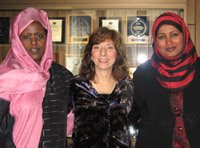 Well, it's been a great day Here on Earth! This morning I had the honor and the pleasure of meeting a fantastic woman named Asha Hagi Elmi who is here in Madison to give the Soffe lecture. She arrived with her traveling companion and the two of them, big, beautiful black women fabulously dressed and be-jeweled in many-layered silks and scarves, Asha wearing silver, black and pink, and her friend in black with a red and black striped head scarf, filled up the reception room like a two-woman U.N. One of the many things I learned from them is that Somalis have no hostility toward their former Italian colonizers, indeed, they eat Italian food, pattern their dress after Italian fashion, and even decorate their homes al'Italiana! Asha was named one of the 1000 women eligible for a Nobel Peace prize and she surely deserves it, having founded an NGO called Save Somali Women and Children which is educating young women, training them for jobs, helping to end forced child marriages and the hideous practice of female genital mutilation. She is also a Machiavellian strategist having used the concept of clan to transcend it by creating The Sixth Clan, all women from various tribes united for political and social power. You'll be hearing from Asha in a future Here on Earth program.
I heard from several of you who were disappointed with our program on fundamentalism with Martin Marty which used a sensational device at the start of the program which juxtaposed The Jesus Camp with a Pakistani mudrassah. I can understand why you objected, and I appreciate your suggestions on constructive ways to depict Christian fundamentalists.
And to those of you who enjoyed meeting The Bioneers, you'll be pleased to know we're planning on future collaborations.
And now, even as I write I'm getting ready for an Ode to Sauerkraut!
Thanks for all your help.
Jean
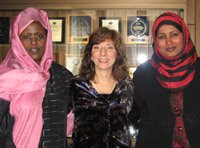 Well, it's been a great day Here on Earth! This morning I had the honor and the pleasure of meeting a fantastic woman named Asha Hagi Elmi who is here in Madison to give the Soffe lecture. She arrived with her traveling companion and the two of them, big, beautiful black women fabulously dressed and be-jeweled in many-layered silks and scarves, Asha wearing silver, black and pink, and her friend in black with a red and black striped head scarf, filled up the reception room like a two-woman U.N. One of the many things I learned from them is that Somalis have no hostility toward their former Italian colonizers, indeed, they eat Italian food, pattern their dress after Italian fashion, and even decorate their homes al'Italiana! Asha was named one of the 1000 women eligible for a Nobel Peace prize and she surely deserves it, having founded an NGO called Save Somali Women and Children which is educating young women, training them for jobs, helping to end forced child marriages and the hideous practice of female genital mutilation. She is also a Machiavellian strategist having used the concept of clan to transcend it by creating The Sixth Clan, all women from various tribes united for political and social power. You'll be hearing from Asha in a future Here on Earth program.
I heard from several of you who were disappointed with our program on fundamentalism with Martin Marty which used a sensational device at the start of the program which juxtaposed The Jesus Camp with a Pakistani mudrassah. I can understand why you objected, and I appreciate your suggestions on constructive ways to depict Christian fundamentalists.
And to those of you who enjoyed meeting The Bioneers, you'll be pleased to know we're planning on future collaborations.
And now, even as I write I'm getting ready for an Ode to Sauerkraut!
Thanks for all your help.
Jean
Friday, September 29, 2006
Interfaith Dialogue on Here on Earth?
September 29, 2006
Hi Guys, It's been a while. I have been madly trying to meet a deadline with the UW Press on my long-awaited book which is due at the end of this month (Yikes!). I've never been without so much sleep for such a long time. I told my husband it was alright with me if he consigned me to the attic or committed me to an asylum. He said, "Please, just promise me you'll never write another book." And this from a man who has stacks of them in every room in the house. Shows you what he'shad to put up with.
Anyway, what with all this flap about the Pope and his humungus gaff about Islam, the thought occurred to me, why not start an ongoing interfaith dialogue right here on the radio, on Here on Earth? Trouble is, such a venture would fly or fail depending on the guests. Do any of you have any suggestions? Know any open-minded rabbis, Imams, or priests? It wouldn't necessarily have to be clerics. Joan Chittister strikes me as someone who might be just right. And I heard a very impressive Imam from Boston on Tom Ashbrook's show about a week ago, responding to the Pope. I would very much appreciate your help with this.
Joe Hardtke, our Techinical Director, is back from Europe, thank God. I hate to let him know how much he was missed. Things went much more smoothly this week, although we did get an inflammatory response from one highly irate listener to Monday's show on "Literature from the Axis of Evil," who claims that if bombs ever start falling on Iran, he's holding me responsible. I do see his point. No wonder some writers from countries like Syria withdrew their submissions once they discovered they would be published in an anthology with such a title.
Any other complaints? We do read them all and post them on our website. Even if it's nasty, we still want to hear from you. We want you to help us shape this program which is still an ongoing experiment.
There will be a Pumpkin Regatta on Lake Mendota this weekend. Maybe I'll see some of you there.
Have a great weekend, especially thoseof you who are headed to Octoberfests.
Best,
Jean
Hi Guys, It's been a while. I have been madly trying to meet a deadline with the UW Press on my long-awaited book which is due at the end of this month (Yikes!). I've never been without so much sleep for such a long time. I told my husband it was alright with me if he consigned me to the attic or committed me to an asylum. He said, "Please, just promise me you'll never write another book." And this from a man who has stacks of them in every room in the house. Shows you what he'shad to put up with.
Anyway, what with all this flap about the Pope and his humungus gaff about Islam, the thought occurred to me, why not start an ongoing interfaith dialogue right here on the radio, on Here on Earth? Trouble is, such a venture would fly or fail depending on the guests. Do any of you have any suggestions? Know any open-minded rabbis, Imams, or priests? It wouldn't necessarily have to be clerics. Joan Chittister strikes me as someone who might be just right. And I heard a very impressive Imam from Boston on Tom Ashbrook's show about a week ago, responding to the Pope. I would very much appreciate your help with this.
Joe Hardtke, our Techinical Director, is back from Europe, thank God. I hate to let him know how much he was missed. Things went much more smoothly this week, although we did get an inflammatory response from one highly irate listener to Monday's show on "Literature from the Axis of Evil," who claims that if bombs ever start falling on Iran, he's holding me responsible. I do see his point. No wonder some writers from countries like Syria withdrew their submissions once they discovered they would be published in an anthology with such a title.
Any other complaints? We do read them all and post them on our website. Even if it's nasty, we still want to hear from you. We want you to help us shape this program which is still an ongoing experiment.
There will be a Pumpkin Regatta on Lake Mendota this weekend. Maybe I'll see some of you there.
Have a great weekend, especially thoseof you who are headed to Octoberfests.
Best,
Jean
Friday, September 15, 2006
A Wild Week
Friday, September 15, 2006
I'm looking back at the week and shaking my head. Boy, did we ever cover a lot of territory, beginning with our 9/11 show with Michael Ratner, followed by the Mexican elections, then on to Tuvan rock throat-singing, then the visionary James Martin with his counter Doomsday take on the future of the 21st century, and ending with a salute to cheddar cheese! Now that's one wild whitewater ride. And all of it done running on fumes without the benefit of the manic Joe Hardtke, our Technical and Creative Director who's been on a looong European vacation, well deserved, but you picked a fine time to leave me, Lucille.
I was very grateful to the callers in the Michael Ratner show, especially to Pat who called in at the very end of the hour and cried. Thank you, Pat. You have restored my faith in my fellow countrymen who seem to have become rather blase at the notion of torture, rendition, and black sites controlled by the CIA. Sorry, but I can't conceal my sorrow and outrage.
And thank you for all those great calls on Tuesday in the Mexican election show! It was very gratifying to get such a robust response. Makes me think a global cultural call-in program on WPR is not such a crazy idea after all.
My favorite program this week was the one with the Tuvan throat singer doing classic rock, but you guys know by now how much I love way-out stuff like that. I hope somebody goes to his concert in Humboldt Park tonight and sends us a report.
My favorite guest this week was James Martin, the British futurist who seems to have so much clear-eyed, level-headed faith in the ability of The Transition Generation to steer us through the whitewater bottleneck ahead. He also has a lot of faith in our capacity to reach an understanding across diverse cultures. He's predicting that by 2050 we'll all be familiar with all the world's diverse cultures. Too bad I won't be around that long.
One more thing: I had a bright idea after hearing Joe Elder give his talk last Wednesday on The Roots of Conflict in the Middle East. What do you think about starting an Interfaith dialogue on Here on Earth? Do any of you know any religious leaders from the three major faiths that might be really good in such a context? One of the points James Martin makes in "The Meaning of the 21st Century" is that the most dfficult task that we face is in avoiding antagonisms among religions. "It would be an irony grander than any in great theater," he says, if the religions that evolved from the teachings of the world's saintly prophets somehow prompted wars that wiped out civilization." Indeed.
Thanks for staying in touch.
Jean
I'm looking back at the week and shaking my head. Boy, did we ever cover a lot of territory, beginning with our 9/11 show with Michael Ratner, followed by the Mexican elections, then on to Tuvan rock throat-singing, then the visionary James Martin with his counter Doomsday take on the future of the 21st century, and ending with a salute to cheddar cheese! Now that's one wild whitewater ride. And all of it done running on fumes without the benefit of the manic Joe Hardtke, our Technical and Creative Director who's been on a looong European vacation, well deserved, but you picked a fine time to leave me, Lucille.
I was very grateful to the callers in the Michael Ratner show, especially to Pat who called in at the very end of the hour and cried. Thank you, Pat. You have restored my faith in my fellow countrymen who seem to have become rather blase at the notion of torture, rendition, and black sites controlled by the CIA. Sorry, but I can't conceal my sorrow and outrage.
And thank you for all those great calls on Tuesday in the Mexican election show! It was very gratifying to get such a robust response. Makes me think a global cultural call-in program on WPR is not such a crazy idea after all.
My favorite program this week was the one with the Tuvan throat singer doing classic rock, but you guys know by now how much I love way-out stuff like that. I hope somebody goes to his concert in Humboldt Park tonight and sends us a report.
My favorite guest this week was James Martin, the British futurist who seems to have so much clear-eyed, level-headed faith in the ability of The Transition Generation to steer us through the whitewater bottleneck ahead. He also has a lot of faith in our capacity to reach an understanding across diverse cultures. He's predicting that by 2050 we'll all be familiar with all the world's diverse cultures. Too bad I won't be around that long.
One more thing: I had a bright idea after hearing Joe Elder give his talk last Wednesday on The Roots of Conflict in the Middle East. What do you think about starting an Interfaith dialogue on Here on Earth? Do any of you know any religious leaders from the three major faiths that might be really good in such a context? One of the points James Martin makes in "The Meaning of the 21st Century" is that the most dfficult task that we face is in avoiding antagonisms among religions. "It would be an irony grander than any in great theater," he says, if the religions that evolved from the teachings of the world's saintly prophets somehow prompted wars that wiped out civilization." Indeed.
Thanks for staying in touch.
Jean
Friday, September 01, 2006
India's Judge Judy
September 1, 2006
My favorite show this week was Monday's "Durga's Court" with the indomitable forever-hoarse Shabnam Ramaswamy, a real firecracker if there ever was one, a self-appointed judge in her native village in India who holds court on her veranda twice a week. The amazing thing is that people actually follow her rulings with no penalties or enforcement policies to make them comply. They just trust her judgement and respect her authority. With some people you just feel as if you've known them all your life. She's one of them. No matter that she's half way across the world and I'll probably never see her. If you happen to have missed that show, I really recommend that you find a way to listen, either on the podcast or the web. She's my pick for this week's Queen of Here on Earth. We're hoping to do a follow-up when documentarian Dheera Sujan produces another Radio Netherlands program about Shabnam's school for street kids, and I'm hoping that we'll be able to generate some support for it.
Another heavy-weight contender for this week's Queen is the ever redoubtable and intrepid and amazingly courageous Sarah Chayes who is fighting guns with roses in Kandahar.
And so far, I haven't gotten stoned for promoting cigar smoking, but close. That one went up in smoke.
I love it when you guys call in. But why do you always make me work so hard at it? What's the difference between the programs that light up like Christmas trees and the ones that stay dark? Why, for example, were there no calls this week for Judge Judy, and only one call for A Force More Powerful? It always feels like a party where nobody shows up when you don't call. Topics too esoteric? Don't know enough to be able to contribute meaningfully to the conversation? You can alway ask questions, you know.
Anyway, have a great Labor Day weekend. Thanks for making my labor worthwhile.
Jean
My favorite show this week was Monday's "Durga's Court" with the indomitable forever-hoarse Shabnam Ramaswamy, a real firecracker if there ever was one, a self-appointed judge in her native village in India who holds court on her veranda twice a week. The amazing thing is that people actually follow her rulings with no penalties or enforcement policies to make them comply. They just trust her judgement and respect her authority. With some people you just feel as if you've known them all your life. She's one of them. No matter that she's half way across the world and I'll probably never see her. If you happen to have missed that show, I really recommend that you find a way to listen, either on the podcast or the web. She's my pick for this week's Queen of Here on Earth. We're hoping to do a follow-up when documentarian Dheera Sujan produces another Radio Netherlands program about Shabnam's school for street kids, and I'm hoping that we'll be able to generate some support for it.
Another heavy-weight contender for this week's Queen is the ever redoubtable and intrepid and amazingly courageous Sarah Chayes who is fighting guns with roses in Kandahar.
And so far, I haven't gotten stoned for promoting cigar smoking, but close. That one went up in smoke.
I love it when you guys call in. But why do you always make me work so hard at it? What's the difference between the programs that light up like Christmas trees and the ones that stay dark? Why, for example, were there no calls this week for Judge Judy, and only one call for A Force More Powerful? It always feels like a party where nobody shows up when you don't call. Topics too esoteric? Don't know enough to be able to contribute meaningfully to the conversation? You can alway ask questions, you know.
Anyway, have a great Labor Day weekend. Thanks for making my labor worthwhile.
Jean
Thursday, August 24, 2006
Lost in the Amazon and Leatherback Turtles
Thursday, August 24, 2006
One of the things I love best about live radio is its unpredictability. I knew Carl Safina was a wonderfully evocative writer, but I didn't think that a whole hour talking about turtles was likely to evoke a lot of callers. You guys were great! It was especially delightful today to hear first from Laura with her story about travelling to Trinidad with Earth Watch to observe leatherbacks laying their eggs, and then in the very next minute to get a call from Bob, her husband, on the road! It was also very inspiring to hear from so many of you who are natural conservationists and obviously care deeply about the natural world. We'll look for more programs like this one. Any of you got any suggestions? I was glad for the tip on Gary Nabham's book, "Singing the Turtles Home."
I'm curious about how you liked Yossi Ghinsburg, the amazing Israeli adventurer who had a narrow escape backpacking in the Amazon as a young man and now lives in the Australian rainforest. I thought he was great, but a friend of mine who listened to the program hated him! He couldn't stand the way he kept denying the malevolence of nature. I myself was skeptical about his assertion that indigenous people don't die from snakebite. I don't think that's really true. Anyway, I'd love to hear from you about any of the above. I tend to write about the programs that I think are successful but it might be more instructive to write about the one that aren't.
By the way - spread the word - we are now podcasting all five of our programs, which is exciting. Some people in New York have been asking about the food programs in particular.
And one more thing - we have a fascinating program coming from Radio Netherlands on Monday about an amazing woman in a little village in India who operates a funky impromptu court to resolve disputes on her veranda - sort of the Judge Judy of India. Try not to miss it. It would be great to have you on board.
One of the things I love best about live radio is its unpredictability. I knew Carl Safina was a wonderfully evocative writer, but I didn't think that a whole hour talking about turtles was likely to evoke a lot of callers. You guys were great! It was especially delightful today to hear first from Laura with her story about travelling to Trinidad with Earth Watch to observe leatherbacks laying their eggs, and then in the very next minute to get a call from Bob, her husband, on the road! It was also very inspiring to hear from so many of you who are natural conservationists and obviously care deeply about the natural world. We'll look for more programs like this one. Any of you got any suggestions? I was glad for the tip on Gary Nabham's book, "Singing the Turtles Home."
I'm curious about how you liked Yossi Ghinsburg, the amazing Israeli adventurer who had a narrow escape backpacking in the Amazon as a young man and now lives in the Australian rainforest. I thought he was great, but a friend of mine who listened to the program hated him! He couldn't stand the way he kept denying the malevolence of nature. I myself was skeptical about his assertion that indigenous people don't die from snakebite. I don't think that's really true. Anyway, I'd love to hear from you about any of the above. I tend to write about the programs that I think are successful but it might be more instructive to write about the one that aren't.
By the way - spread the word - we are now podcasting all five of our programs, which is exciting. Some people in New York have been asking about the food programs in particular.
And one more thing - we have a fascinating program coming from Radio Netherlands on Monday about an amazing woman in a little village in India who operates a funky impromptu court to resolve disputes on her veranda - sort of the Judge Judy of India. Try not to miss it. It would be great to have you on board.
Wednesday, August 16, 2006
Ubundu and Tikkun
Well, guys, I don't know about you, but after hearing from Fadli, Johnny, and then Sivuyile, the Xhosa man last week, I'm tempted to invest in South Africa. And after that, I'm probably going to join Michael Lerner's spiritual progressives. Any club that's smart enough to invite Joan Chittister is good enough for me. It was wonderful to hear Michael Lerner's passion about his plan to bring a lasting peace to the Middle East, and the generosity behind his idea to start a Global Marshall Plan. And I loved the way he stood up to the caller who accused him of leading the Jews into another Holocaust. When you think about it, his ideas are not very different from what Sivuyile described as Ubundu - I am who I am because of you. After hearing Sivuyile talk about Ubundu on Here on Earth last Wednesday, someone who had lived in South Africa sent an email telling how schoolchildren there used to leave a little bit of their lunch for a kid who didn't have any food, but in such a way as to allow him to save face. Now if we could just do that in places like Palestine and Lebanon....
Does this make any sense?
Does this make any sense?
Thursday, August 03, 2006
A Day in the Life...
Thursday, Aug. 3, 2006
Today was Here on Earthian - I bumped into Parker Palmer in the hall, which is a little like bumping into an oak tree. Parker has been one of the great inspirations for Here on Earth ever since I had an "Ah-hah!" moment during a show we did together on "Invisible Communities" many years ago when I suddenly came to understand my talk show as a kind of Kurt Vonnegut "karrass: a community of people who don't know each other, who have never met, but who somehow manage to God's will."
Then I got to spend an hour with two South African men, one of whom looks like Zorba the Great and the other like the King of Siam, talking about teaching science in South Africa - a huge challenge in a country where only whites were permitted to study math and science under apartheid. There are here at the UW as part of an exciting exchange program begun by Raymond Kessel, a South African geneticist on campus. We're hoping to do more programs on South Africa in the future.
No sooner did the program end, then I got whisked away by my crazy Haitian friend, Babette, who has just adopted an adorable eleven-year old child named Tara who can only say two words in English - "Thank you" - and who tried (unsuccessfully) to teach me how to say my name in Creole, trying very hard to keep from hooting at the results.
Now that's what I call a Here on Earth day!
By the way, to those of who have been sending your encouraging comments to our website, a heartfelt "Thank you." You're a lifeline.
Today was Here on Earthian - I bumped into Parker Palmer in the hall, which is a little like bumping into an oak tree. Parker has been one of the great inspirations for Here on Earth ever since I had an "Ah-hah!" moment during a show we did together on "Invisible Communities" many years ago when I suddenly came to understand my talk show as a kind of Kurt Vonnegut "karrass: a community of people who don't know each other, who have never met, but who somehow manage to God's will."
Then I got to spend an hour with two South African men, one of whom looks like Zorba the Great and the other like the King of Siam, talking about teaching science in South Africa - a huge challenge in a country where only whites were permitted to study math and science under apartheid. There are here at the UW as part of an exciting exchange program begun by Raymond Kessel, a South African geneticist on campus. We're hoping to do more programs on South Africa in the future.
No sooner did the program end, then I got whisked away by my crazy Haitian friend, Babette, who has just adopted an adorable eleven-year old child named Tara who can only say two words in English - "Thank you" - and who tried (unsuccessfully) to teach me how to say my name in Creole, trying very hard to keep from hooting at the results.
Now that's what I call a Here on Earth day!
By the way, to those of who have been sending your encouraging comments to our website, a heartfelt "Thank you." You're a lifeline.
Tuesday, July 25, 2006
We Need Your Help
Tuesday, July 25, 2006
We need your help. When we started our new schedule two weeks ago, the entire staff made a mighty effort to get two weeks ahead so that we could promote our programs and start building a wider audience. That was before the outbreak of this new wave of violence in the Middle East. Now please understand something - Here on Earth is dedicated to shining a light in the world's darkness and bringing hope and inspiration to its listeners. Finding the light in this particular situation is a huge challenge. Hence, the lag time last week. It must have seemed to some of you that we were fiddling while Rome burned. We got back on track with Joe Elder today, and tomorrow we're doing a program about a new video game called Peacemaker that teaches players about the real complexities of the conflict. Here's where you come in: if any of you have any suggestions regarding angles, organizations, individuals, or visionaries who can illuminate the current crisis, give people direction and/or hope, and suggest a possible path to peace, we'd like to hear about it. You can post your suggestions right here on my blog or send send them to hereonearth@wpr.org. Thank you so much! This is your chance to be a real collaborator.
We need your help. When we started our new schedule two weeks ago, the entire staff made a mighty effort to get two weeks ahead so that we could promote our programs and start building a wider audience. That was before the outbreak of this new wave of violence in the Middle East. Now please understand something - Here on Earth is dedicated to shining a light in the world's darkness and bringing hope and inspiration to its listeners. Finding the light in this particular situation is a huge challenge. Hence, the lag time last week. It must have seemed to some of you that we were fiddling while Rome burned. We got back on track with Joe Elder today, and tomorrow we're doing a program about a new video game called Peacemaker that teaches players about the real complexities of the conflict. Here's where you come in: if any of you have any suggestions regarding angles, organizations, individuals, or visionaries who can illuminate the current crisis, give people direction and/or hope, and suggest a possible path to peace, we'd like to hear about it. You can post your suggestions right here on my blog or send send them to hereonearth@wpr.org. Thank you so much! This is your chance to be a real collaborator.
Monday, July 17, 2006
Week Two and Still Panting
Dear Friends,
Those of you who were listening lastTuesday when Charlayne Hunter-Gault was my guest might have noticed that she seemed distracted at the start of the program and out of breath. Well, here's a little sneak peek behind-the-scenes. It turns out that our star reporter was having her telephone line worked on that day, and when we called her at the start of the program, her cellphone was running out of juice. So she took to the streets and was literally running around her neighborhood trying to get somebody to let her use their landline while talking to me on the air! Now, that's a first.
I hope you liked the conversation with Colin Channer and Kwame Dawes today as much as we did. I worried that a program about new writing from Jamaica might be too obscure, but Bob Marley, the reggae beat, great guests, and two good callers carried the day.
Please let us know what you think. I love it when you write back.
Jean
Those of you who were listening lastTuesday when Charlayne Hunter-Gault was my guest might have noticed that she seemed distracted at the start of the program and out of breath. Well, here's a little sneak peek behind-the-scenes. It turns out that our star reporter was having her telephone line worked on that day, and when we called her at the start of the program, her cellphone was running out of juice. So she took to the streets and was literally running around her neighborhood trying to get somebody to let her use their landline while talking to me on the air! Now, that's a first.
I hope you liked the conversation with Colin Channer and Kwame Dawes today as much as we did. I worried that a program about new writing from Jamaica might be too obscure, but Bob Marley, the reggae beat, great guests, and two good callers carried the day.
Please let us know what you think. I love it when you write back.
Jean
Monday, July 10, 2006
We're Off and Running!
Hi Guys,
Today was a big day for Here on Earth - we began broadcasting on our new weekday schedule- three o'clock Monday through Friday - out of a brand new studio that's been converted just for us! And, to make sure that absolutely nothing would be familiar, I'm typing this on a brand new keyboard that, for the first five minutes, recorded everything I wrote in numbers rather than letters!
Anyway, everything went off pretty much without a hitch. It's a bit crowded in Studio B, but it feels cozy and intimate, as a radio studio should. I feel certain we are likely to attract a much wider audience in the new time slot, with a lot more callers to draw from. I feel encouraged that our program today, about African-Americans returning to Africa, attracted two African callers in addition to a few Wisconsinites: Annette, a Franco-African originally from Martinique, and our old friend, Hadde, from Mali, who has happily migrated with us from weekendsto weekdays. Thank you, Hadee, and to everyone else who called in today! We're hoping to create a much more interactive program, with many more opportunities for all of you to help us shape the program. So, please, by all means let us know what you think. If you didn't get on the air today, you can still register your thoughts on my blog, by emailing us at hereonearth@wpr.org (the email wasn't working today for some reason, but we'll fix that), or by posting a comment on our forum.
A heads-up for next week: On Tuesday, my guest will be Erik Weihenmayer, the first blind man to summit Mt. Everest. He just returned from leading a mixed group of teenagers - some sighted, some blind- on an expedition to Macchu Picchu.
Any great show ideas out there? We'd love to hear 'em! Keep those cards and letters coming! And, by the way, we'll be posting some pictures from my trip to Italy later this week, andLisa Nett has a review of Favela Rising she wants to share. I saw it too. Great stuff.
Bye for now,
Jean
Today was a big day for Here on Earth - we began broadcasting on our new weekday schedule- three o'clock Monday through Friday - out of a brand new studio that's been converted just for us! And, to make sure that absolutely nothing would be familiar, I'm typing this on a brand new keyboard that, for the first five minutes, recorded everything I wrote in numbers rather than letters!
Anyway, everything went off pretty much without a hitch. It's a bit crowded in Studio B, but it feels cozy and intimate, as a radio studio should. I feel certain we are likely to attract a much wider audience in the new time slot, with a lot more callers to draw from. I feel encouraged that our program today, about African-Americans returning to Africa, attracted two African callers in addition to a few Wisconsinites: Annette, a Franco-African originally from Martinique, and our old friend, Hadde, from Mali, who has happily migrated with us from weekendsto weekdays. Thank you, Hadee, and to everyone else who called in today! We're hoping to create a much more interactive program, with many more opportunities for all of you to help us shape the program. So, please, by all means let us know what you think. If you didn't get on the air today, you can still register your thoughts on my blog, by emailing us at hereonearth@wpr.org (the email wasn't working today for some reason, but we'll fix that), or by posting a comment on our forum.
A heads-up for next week: On Tuesday, my guest will be Erik Weihenmayer, the first blind man to summit Mt. Everest. He just returned from leading a mixed group of teenagers - some sighted, some blind- on an expedition to Macchu Picchu.
Any great show ideas out there? We'd love to hear 'em! Keep those cards and letters coming! And, by the way, we'll be posting some pictures from my trip to Italy later this week, andLisa Nett has a review of Favela Rising she wants to share. I saw it too. Great stuff.
Bye for now,
Jean
Subscribe to:
Posts (Atom)


 Posts
Posts

